Preparing a bill of quantities in Austria: a complete guide (LBH, ÖNORM)
How a bill of quantities (Leistungsverzeichnis) is structured in Austria, which ÖNORM standards apply, what the standard specification for building construction (LBH) is, and how to prepare one step by step.
23 June 2026 · 8 min read
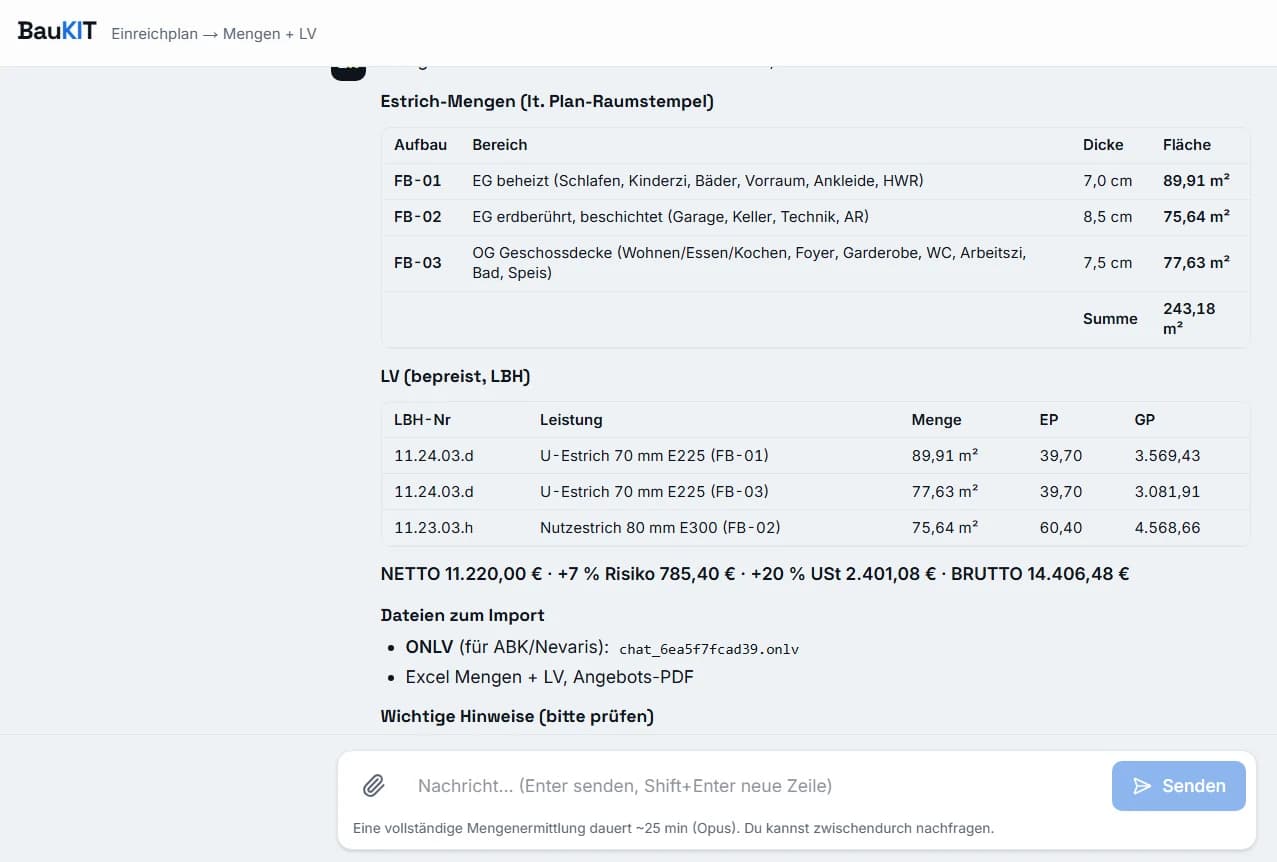
The bill of quantities is the backbone of every construction tender. If it is clean, complete and compliant, award and invoicing run smoothly. If it has gaps, variations, disputes and cost overruns follow. This guide shows how a bill of quantities is structured in Austria, which standards apply and how to arrive at a reliable one in clear steps.
What is a bill of quantities?
A bill of quantities (Austrian: Leistungsverzeichnis, LV) is the structured, item-by-item list of all construction work to be performed in a project, each with a quantity, a unit and an unambiguous description of the work. For every trade it answers the question: what has to be done, in what quantity and quality? That makes it the common language between client, designer and contractor, and the basis for tendering, bidding, award and invoicing.
A single entry in the bill is called a line item (Position). A typical line item consists of an item number, a short and a long text (the description of the work), quantity, unit and, in a priced bill, the unit price and the total price (total = quantity × unit price).
Bill of quantities, quantity takeoff and cost estimate compared
These three terms are often mixed up, but they mean different things:
- Quantity takeoff: determines the pure quantities from the plan (e.g. 243 m² of screed). More in the article Quantity takeoff from permit plans.
- Bill of quantities: assigns standardised line items and work descriptions to those quantities and, with prices, makes them possible to price and invoice.
- Cost estimate: an early, rougher forecast of total costs, often before a detailed bill of quantities exists.
How a bill of quantities is structured
A complete bill of quantities is usually divided into:
- Preliminaries: project-specific conditions, site circumstances, applicable standards and general provisions.
- Work groups (LG) and sub-groups (ULG): the thematic structure, mostly by trade (e.g. earthworks, concrete, screed, windows).
- Line items: the individual items of work with quantity, unit and description, the actual content of the bill.
Line items are further divided into normal items (firmly priced), provisional items (only if needed) and alternative items (options). Keeping these clearly separate prevents misunderstandings at invoicing.
The ÖNORM basics
In Austria, tendering relies on an established set of standards:
- ÖNORM A 2063 governs the electronic exchange of tender, bid, contract and invoicing data. The ONLV format it defines is the standard for exchanging bills of quantities between programs.
- ÖNORM B 2061 describes the pricing of construction work, the basis for traceable unit prices and the familiar K sheets (price calculation forms).
- Standardised specifications such as LB-HB (Leistungsbeschreibung Hochbau, often called LBH) provide uniformly numbered, pre-written item texts.
ONLV and ONLB: the exchange formats
For a bill of quantities to move between client, designer and contractor, and between different programs, a common file format is needed. ÖNORM A 2063 defines two central ones:
- ONLB: the standardised specification without project-specific quantities. It supplies the item texts to choose from.
- ONLV: the project-specific bill of quantities with the selected line items and the actual quantities. Optionally priced, it becomes the bid or invoicing file.
In practice this means that if you export your bill of quantities as ONLV, it can be read without loss into common tendering programs such as Nevaris, ABK or Auer Success, without retyping a single line item.
Why the standard specification (LBH) matters
Instead of writing every line item freely, tenderers use the standardised specification for building construction. Every item there has a fixed number and a vetted text, for example “11.24.03 Unterlagsestrich” (bonded screed). That brings three advantages:
- Comparability: bids from different firms refer to the same text and can be compared directly.
- Legal certainty: the texts are proven and compliant, which reduces disputes over interpretation.
- Efficiency: no rewriting, fewer mistakes, faster preparation.
Preparing the bill step by step
- Take off quantities: derive quantities per element and trade from the plan, with a traceable derivation.
- Assign line items: assign each quantity to the right LBH item with the correct work text.
- Structure: organise line items into work groups and sub-groups.
- Add preliminaries: record the site conditions and particularities.
- Price (optional): apply unit prices, for the client’s budget or the contractor’s bid.
- Export: as an ONLV file for the tender or for import into the tendering software.
Common mistakes in bills of quantities
- Forgotten line items: ancillary work such as edge insulation strips, joints or connections is missing and later reappears as a variation.
- Wrong units: m² instead of running metres, or pieces instead of m³: a small typo with a large price effect.
- Unclear work texts: freely worded items without reference to the LBH leave room for interpretation.
- Quantities without evidence: figures whose derivation nobody can reconstruct are a risk at review and invoicing.
Invoicing: remeasurement or lump sum
How the bill will be invoiced should be clear from the start, because it determines how carefully quantities are prepared:
- Unit-price contract (remeasurement): the quantities actually performed are invoiced at the agreed unit prices. The quantities in the bill are provisional and deviations are corrected by measurement. A documented quantity takeoff is worth its weight in gold here.
- Lump-sum contract: a fixed price for the work described. A complete bill matters all the more: whatever is not in it is not paid for and leads to variations.
In both cases: the more traceably the quantities are derived, the less the bill can be challenged at review and invoicing.
Checklist before the bill goes out
- Are all trades and ancillary work covered?
- Do units and quantities match the plan?
- Do the line items refer to standardised LBH texts?
- Are provisional and alternative items marked as such?
- Do the preliminaries contain the relevant conditions?
- Is every quantity backed up with a derivation?
- Is the bill ready as ONLV for import?
Preparing the bill automatically
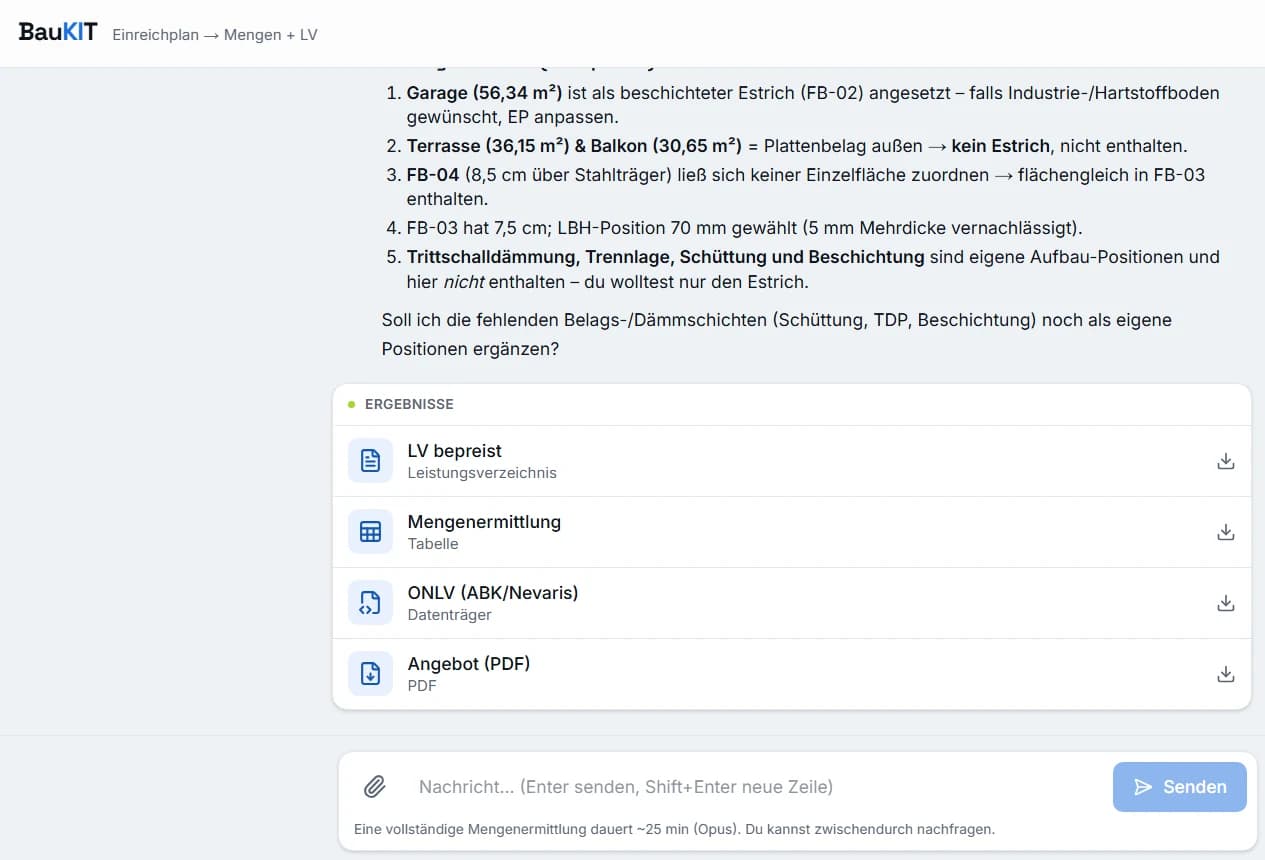
Traditionally a bill of quantities takes hours to days of manual work. This is where BauKIT comes in: from the uploaded permit plan, the AI generates a quantity takeoff and a priced bill of quantities based on LBH items, every quantity with a traceable derivation and checked against ÖNORM, OIB and BauKG. The result can be exported as an ONLV file directly to Nevaris, ABK or Auer Success.
Days of groundwork become a task of minutes, and every line item stays checkable.